Mortar is the single most misunderstood material in NYC masonry. We've spent thirty years getting it right.
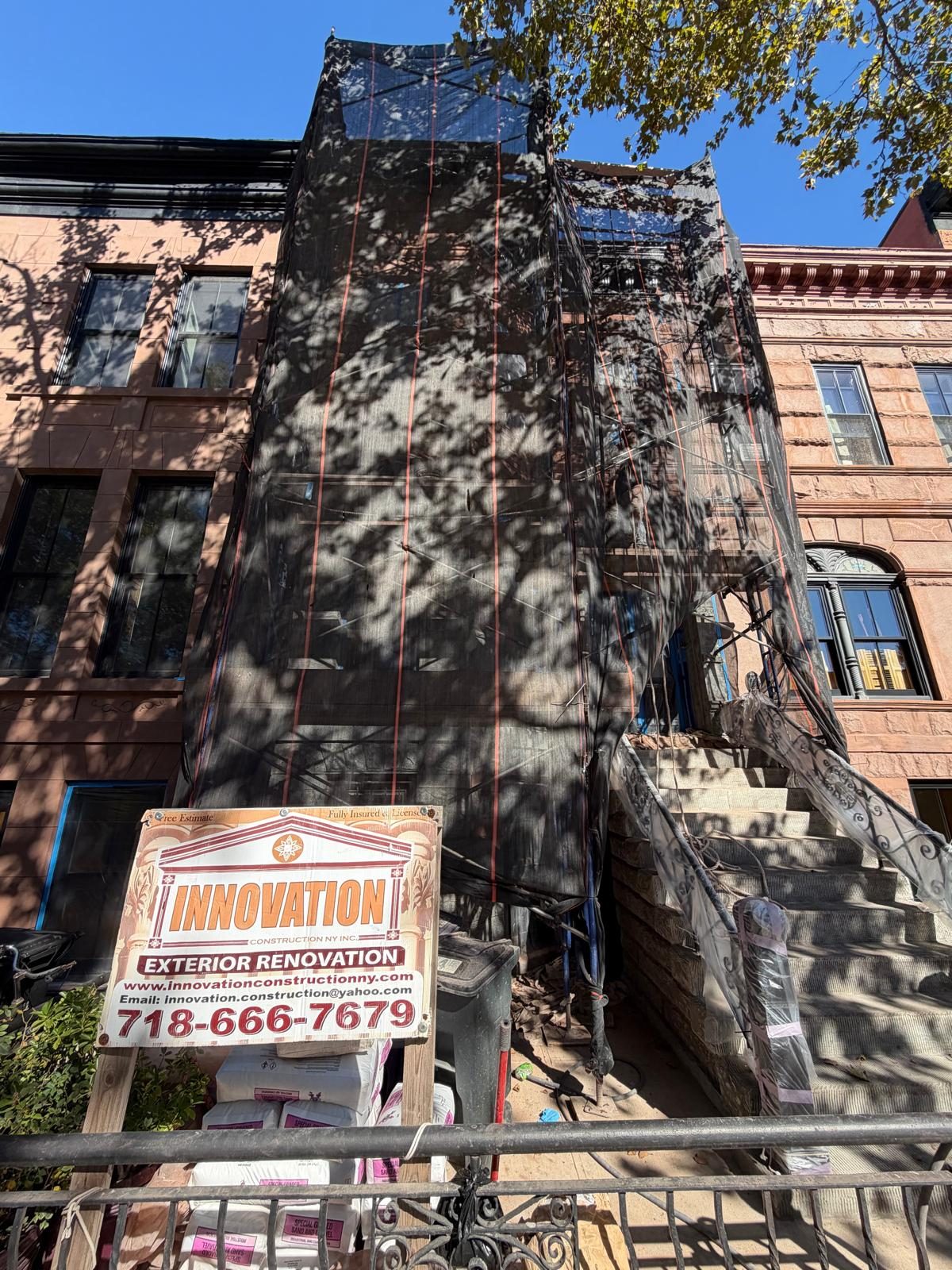
Brick pointing is the most common — and most commonly bungled — masonry repair in New York. The premise sounds simple: the mortar between the bricks has receded, so you grind it out, mix new mortar, push it back into the joints. In practice, the choice of mortar mix, the depth of the grind, the joint profile, and the curing conditions determine whether the repair lasts thirty years or five.
The single biggest mistake in NYC brick pointing is using modern Portland cement on historic masonry. Portland cement is harder than the brick it surrounds. When the wall expands and contracts with temperature — and NYC sees a 90°F annual swing — the soft brick fractures around the hard mortar instead of the soft mortar cracking around the brick. The brick face spalls off. Within ten years the original surface is gone forever.
We use natural hydraulic lime (NHL) mortar matched to the original mix on every pre-1900 building. NHL is softer than the brick, breathable, and self-healing — microcracks recarbonate over time. The match for any particular building is determined by analyzing a sample of the original mortar: lime-to-aggregate ratio, aggregate color and grading, and any pozzolanic additions.
No black box. Here is the exact sequence we follow on every project, from first phone call to final inspection.
We collect a small sample of the original mortar and analyze it for binder-to-aggregate ratio, aggregate color, grading, and any pigments or additives. The new mix matches the original — not a generic 'historic' formula.
Failed mortar is ground out to a depth of 2-2.5 times the joint width (typically 3/4" to 1"). We use small hand-held electric grinders with carbide bits — never pneumatic chipping hammers, which fracture brick edges.
All dust, loose material, and old gypsum-based mortar are removed with low-pressure water rinsing or vacuum. Brick faces are pre-wetted before pointing to prevent the lime from drawing too quickly.
Fresh NHL mortar is packed into the joints in thin lifts (no more than 1/2" per pass) and tooled to match the original profile — concave, V-joint, weather-struck, or beaded.
For true historic tuckpointing — found on some Federal-era brick — we apply a base mortar matching the brick color, then tuck a thin contrasting lime putty line down the center to create the appearance of perfectly thin joints.
Lime mortar cures by carbonation, not hydration. We keep the wall lightly moist for 7 days after pointing — covered with damp burlap in summer, plastic in winter. Full cure takes 28 days.
Materials matter as much as workmanship. The wrong material can shorten a façade's life by decades.
The most common — and most expensive — mistakes we see on prior unsuccessful restoration work.
Brick pointing in NYC typically runs $18-$35 per square foot, depending on access, scaffolding requirements, joint depth, and LPC review. A standard 3-story Brooklyn brownstone has roughly 1,800-2,400 sq ft of brick face.
Properly executed NHL lime mortar pointing on a Brooklyn brownstone should last 80-100 years. Portland cement pointing — done poorly — often needs to be redone within 15-20 years, and by then it has usually damaged the surrounding brick.
Brick pointing is the general repair of mortar joints — grinding out the failed mortar and refilling. Tuckpointing is a specific historic technique where a base mortar matching the brick color is applied, then a thin contrasting line of fine lime putty is 'tucked' into the center to make the joints appear narrow and uniform. True tuckpointing is rare today and is mostly found on Federal-era brick.
Not on any pre-1900 building. Hardware store bagged mortar is almost always Type N or Type S — both Portland cement formulations that are too hard for historic brick. Use only NHL lime mortar mixed to match the original.
Yes. We perform the masonry repairs identified by Local Law 11 (FISP) inspections on buildings over six stories, file the closeout reports, and resolve DOB violations. We are NYC DOB-licensed and LPC-approved.
Free on-site assessment. Written estimate within five business days. No fee, no obligation.