The most demanding masonry work in New York, done the way it was done in 1880 — by hand, with original materials.
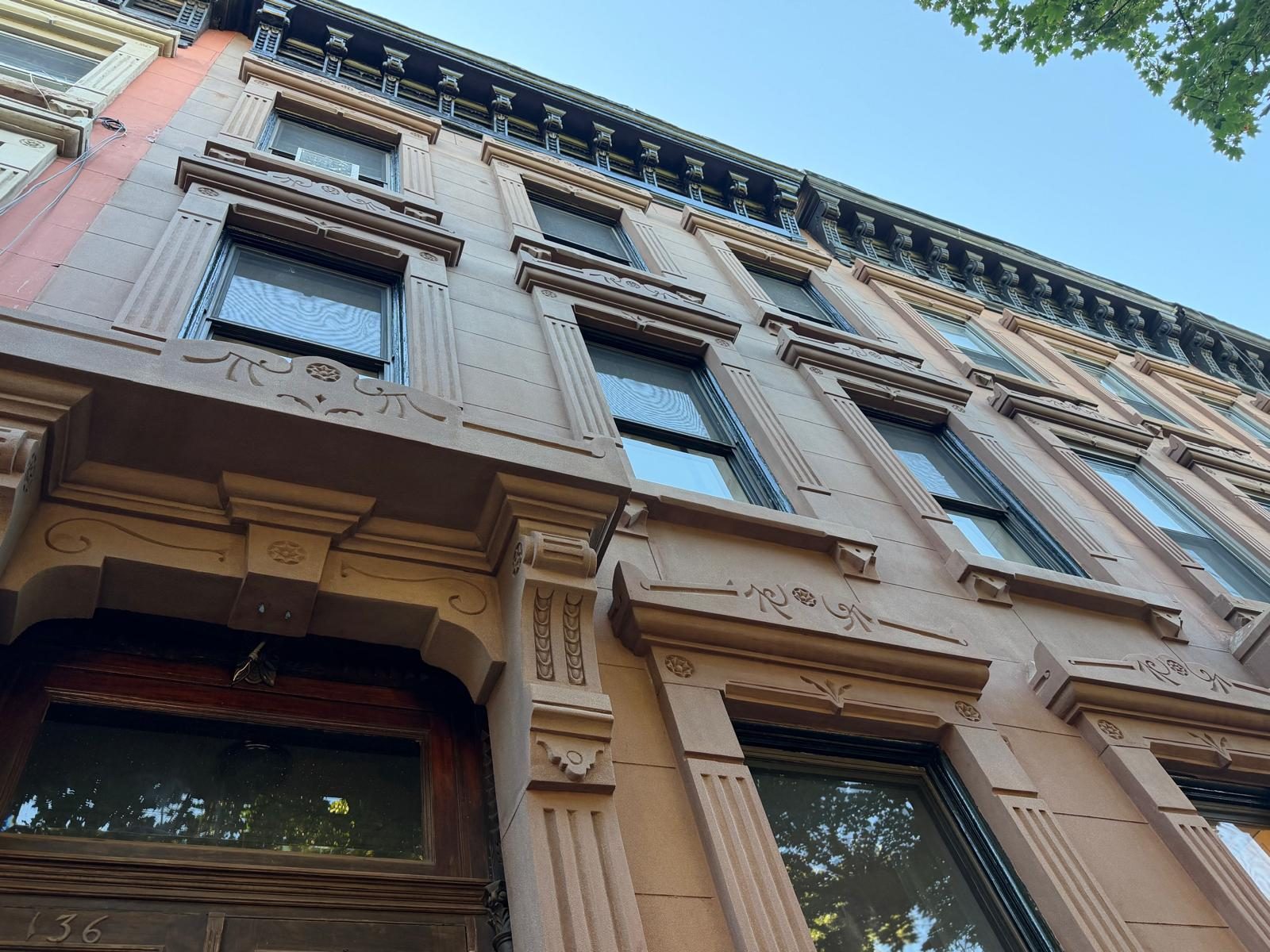
Brownstone is a soft sandstone — beautiful, warm, and remarkably fragile. The brownstones of New York were quarried from the Connecticut River Valley and the Portland, Connecticut quarries in the mid-1800s, then shipped down the East River to be cut, carved, and laid by hand on the row houses of Brooklyn, Manhattan, and Harlem. After 120 to 160 years of New York weather, the failure mode is not catastrophic — it is gradual, accumulating, and invisible until pieces start falling.
We have restored more than 500 brownstone façades since 1995. Our work covers everything from spot repairs on a single window hood to a complete four-story façade reconstruction with stoop, balustrades, and historic preservation review. Every project is performed by the same in-house crew — no subcontractors, no rotating teams. Ekram Hossain, our founder and master mason, walks every site at the diagnostic and final inspection phases.
The single most important decision in any brownstone restoration is the diagnosis. Surface flaking can be a sign of three different underlying problems, each requiring a different repair. The wrong repair — most commonly a synthetic stucco patch or a Portland-cement-based mortar — will fail within a decade and accelerate the damage to the original stone. Diagnosis is half the work.
No black box. Here is the exact sequence we follow on every project, from first phone call to final inspection.
Ekram or a senior estimator visits the property, photographs the façade, identifies the stone type and original quarry, and tests the existing mortar with a calcium-carbonate kit. We deliver a written diagnosis and estimate within five business days. No fee.
For landmarked properties, we prepare and file the Certificate of No Effect (CNE), Permit for Minor Work, or Certificate of Appropriateness (C of A) — depending on scope. We attend hearings and revise drawings until approval.
Sidewalk shed, scaffolding, and protective netting installed to NYC DOB specifications. Adjacent neighbors notified. Pedestrian access maintained at all times.
Sounding hammer survey identifies all hollow or detached units. Failed material is removed by hand with mechanical cutters — never pneumatic tools that can crack adjacent stones. Original profiles are documented before removal.
We hand-cast brownstone replacement units on site using pigmented hydraulic lime aggregates color-matched to the original. For carved detail — corbels, window hoods, modillions, keystones — our carvers replicate from rubbings and photographs.
New units are set in NHL 3.5 lime mortar on full beds. Joints are pointed flush, then weather-struck or beaded to match the original profile. Cure time is 28 days minimum before any topcoating.
Where appropriate, we apply a breathable mineral silicate sealer — never a synthetic coating. Ekram walks the completed façade with the homeowner and signs off.
Materials matter as much as workmanship. The wrong material can shorten a façade's life by decades.
The most common — and most expensive — mistakes we see on prior unsuccessful restoration work.
A full façade and stoop restoration on a three-story Brooklyn brownstone typically ranges from $80,000 to $250,000, depending on scope, condition, scaffolding requirements, and LPC oversight. Smaller spot repairs start around $8,000–$15,000. We provide free written estimates within five business days after an on-site assessment.
Eight to twelve weeks for a complete façade and stoop restoration. Weather, scaffolding logistics, and LPC review timelines can extend this for landmarked properties. Smaller projects — repointing only, or stoop repair — can be completed in two to four weeks.
Both are sedimentary stones, but they age differently. Brownstone (a sandstone) spalls, flakes, and 'sugars' — the surface breaks down into individual sand grains. Limestone dissolves slowly in acid rain, creating smoother but more eroded carved detail. The repair approach is different: brownstone gets hand-cast replacement units, limestone is often consolidated and recarved in place.
Yes — we are an LPC-approved historic contractor and file all permit documentation in-house. We've worked across Brooklyn Heights, Park Slope, Cobble Hill, Carroll Gardens, Fort Greene, Stuyvesant Heights, Bedford, Greenwich Village, Upper West Side, and other NYC historic districts.
Sometimes — and when spot repair is the right call, we'll tell you. But if the cause is water infiltration from above (failed cornice, roof, or parapet), patching the symptom will fail within 3-5 years. Always start with the diagnosis.
Free on-site assessment. Written estimate within five business days. No fee, no obligation.